Home in Time
On 24 October 2025, Kunsthaus Graz hosted the inter- and transdisciplinary cooperation event "HOME IN TIME. Or how we can live together" took place. The organisers were Office Ukraine. Support for Ukrainian Artists, < rotor > Centre for Contemporary Art, the University of Graz (GEWI focus area Multilingualism, Migration, Cultural Transformation and the Institute for Cultural Anthropology), the Styrian Anti-Discrimination Agency and the Kunsthaus Graz. The event was dedicated to the question of how coexistence can be organised not only between so-called migrants*migrants and hostsbut also within societies characterised by crises, polarisation and change.
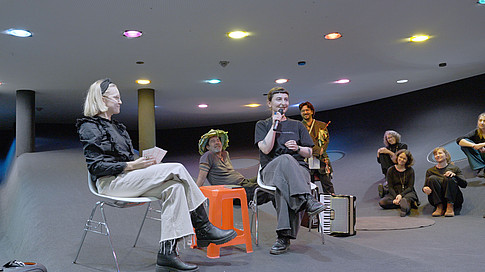
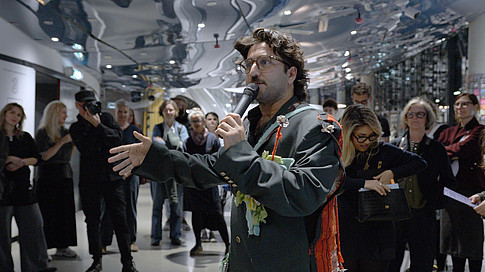
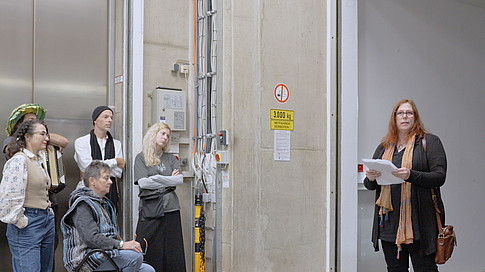
The evening was conceived as a choreographed, performative assembly that was composed of theoretical, musical and performative contributions like a "string of pearls". The contributions, which took place at various stations in the Kunsthaus, were dedicated to topics such as migration, multilingualism, coexistence and the fragile forms of living together. The individual stations were linked by a series of key concepts such as home, time, language, translation and One World.
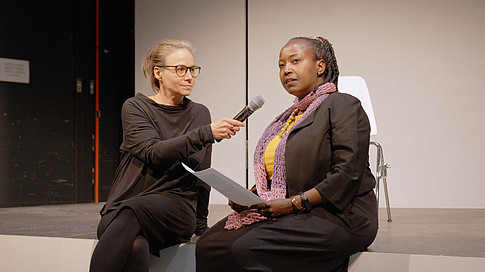
The actor and theatre maker Zaid Alsalame guided the visitors through the evening. Musical highlights were provided by Sandy Lopičić and the SoSamma Women's Choir. Sociologist (graduate of a sociology degree programme at the University of Graz) and human rights award winner Edith Abawe shared her personal experiences of migration in an interview with cultural anthropologist Judith Laister (University of Graz). Cultural anthropologist Alexandra Schwell (University of Klagenfurt) challenged the concept of "home" in a scientific-literary essay. Asiyeh Panahi (law student at the University of Graz) read her literary text from the anthology "The Long Winter of Migration" in Farsi and German. Stephanie Sackl (graduate of the European Ethnology programme at the University of Graz) and Margo Sarkisova discussed the controversial concepts of nationalism/national identity, refugee/migrantfrom the perspective of a refugee woman in the form of a game. And Kamdem Mou Poh à Hom reminded the audience of the importance of political co-determination, especially in times of reduced cultural and social budgets.
The event was held in several languages - English, German, Ukrainian, Bosnian and Farsi - and attracted numerous visitors. It opened up a space for the mutual perception of and exchange between academics, artists, cultural workers and the public, which was able to address the challenges and opportunities of living together in a globalised world in an impressive way.